Breville Barista Express vs Barista Pro: Which Should You Buy?
Short on time?
Buy the Breville Barista Pro if you make milk drinks most days or hate waiting: it heats in about 3 seconds, has 30 grind settings, an LCD shot timer and a faster four-hole steam wand. Buy the Breville Barista Express if you want the lower-priced machine, like an analog pressure gauge and mostly drink straight espresso or one latte at a time. Both use the same 54 mm portafilter, 67 oz water tank and a built-in conical burr grinder, so the espresso itself is closer than the feature lists suggest.
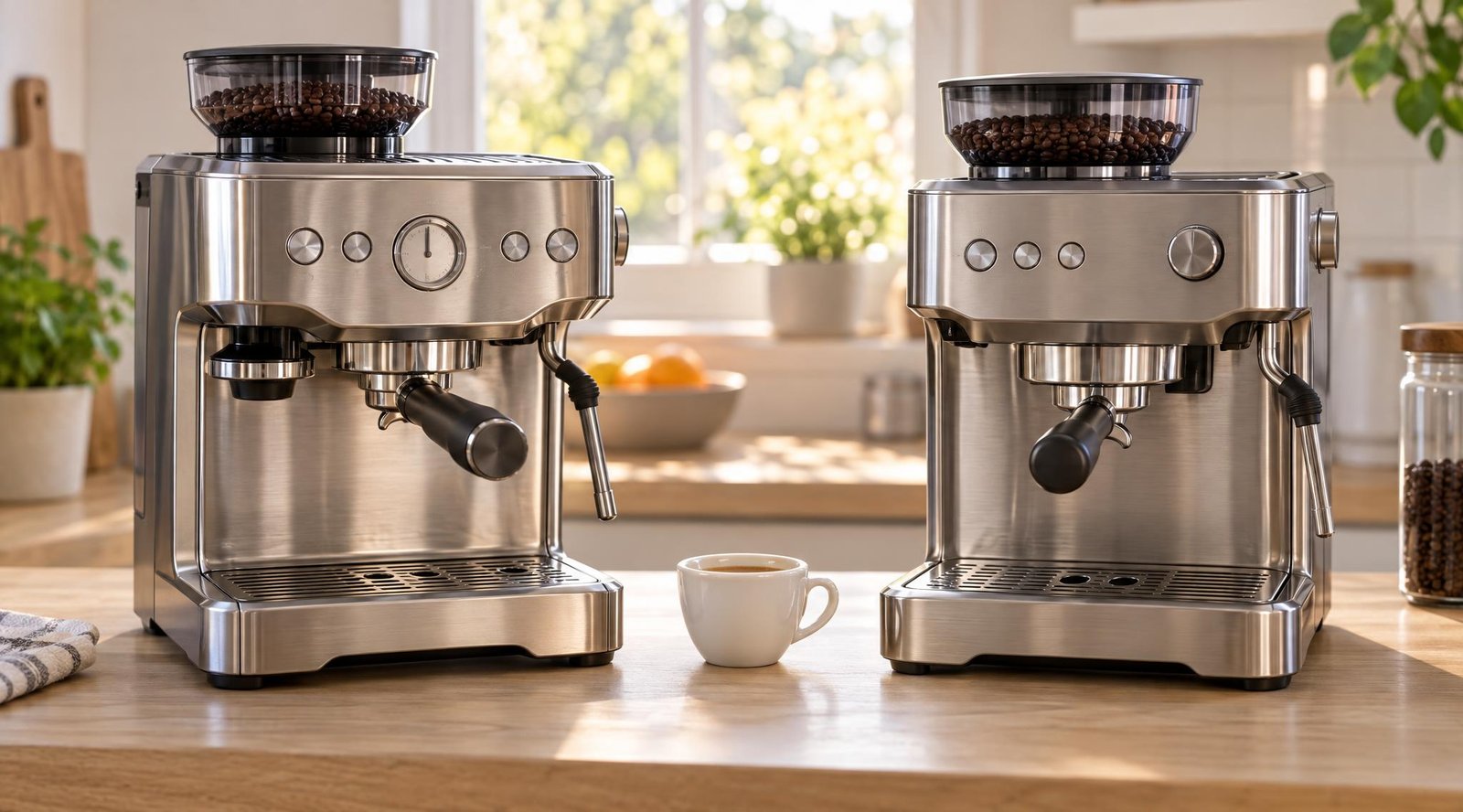
In the Breville Barista Express vs Barista Pro matchup, the Pro is the faster and more precise machine, and the Express is the better value. The Pro’s ThermoJet heater is ready in about 3 seconds and its grinder has 30 settings, while the Express uses an older Thermocoil heater, has 16 grind settings and adds a pressure gauge the Pro does not have.
This comparison is based on manufacturer specifications, published features and common owner feedback, not on hands-on testing. Prices move around a lot on these two, so check the current price on Amazon before you decide how much the Pro’s extras are worth to you.
The Machines in This Comparison
Breville Barista Express (BES870XL) – mid-range value pick with a pressure gauge
Breville Barista Pro (BES878) – 3 second heat-up, 30 grind settings, LCD
Breville Barista Express Impress (BES876) – adds assisted tamping and dosing
Breville Barista Touch (BES880) – touchscreen and automatic milk texturing
Breville Barista Express vs Barista Pro: Specs Side by Side
| Feature | Barista Express (BES870XL) | Barista Pro (BES878) |
|---|---|---|
| Heating system | Thermocoil with PID temperature control | ThermoJet with PID temperature control |
| Heat-up time | About 30 to 60 seconds, depending on the source | About 3 seconds (Breville’s figure) |
| Built-in grinder | Conical burr, 16 grind settings | Conical burr, 30 grind settings |
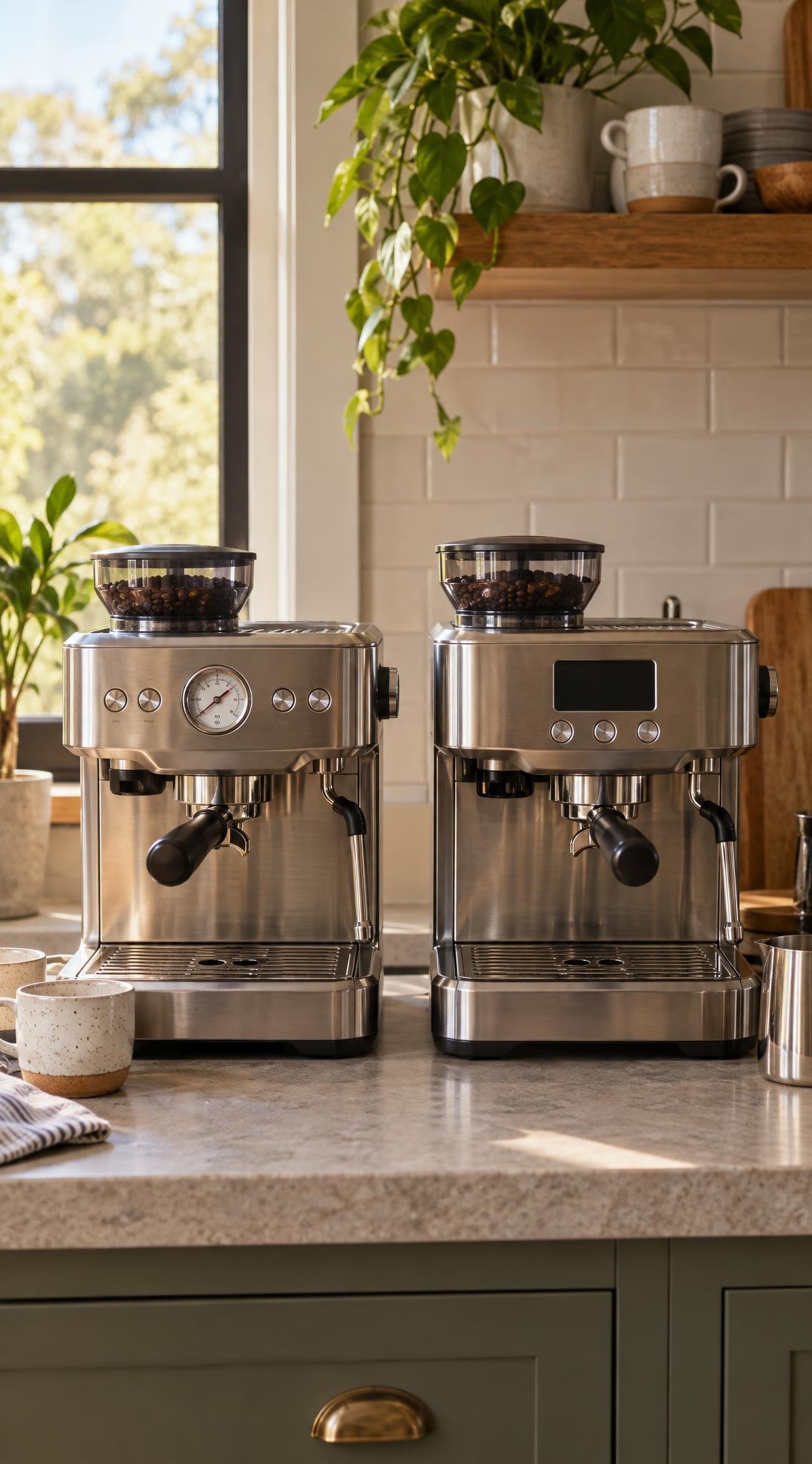
| Interface | Buttons, dials and an analog pressure gauge | Backlit LCD with shot timer, no pressure gauge |
| Steam wand | Manual wand, single-hole tip | Manual wand, four-hole tip |
| Pump | 15 bar Italian pump, low-pressure pre-infusion | 15 bar Italian pump, low-pressure pre-infusion |
| Portafilter | 54 mm, single and dual wall baskets | 54 mm, single and dual wall baskets |
| Water tank | 67 oz, removable | 67 oz, removable |
| Bean hopper | 1/2 lb (8 oz) | 1/2 lb (8 oz) |
| Listed dimensions | 15.9 x 13.1 x 12.4 in | 16.1 x 13.8 x 13.1 in |
| Price tier | Mid-range, usually the lower of the two | Mid-range to premium, usually higher |
Breville’s own pages list the three dimensions in an order that does not match most retailer listings, so treat them as a guide. Both machines stand roughly 16 inches tall with the hopper on and take up a similar patch of counter. Measure the space under your cabinets before you order either one.
What Is the Same on Both Machines?
More than you might expect. Both are single-heater, semi-automatic machines with a built-in conical burr grinder that grinds straight into a 54 mm stainless steel portafilter. Both use a 15 bar Italian pump with low-pressure pre-infusion, PID temperature control, a 67 oz removable water tank and a 1/2 lb bean hopper.
Both also come with single and dual wall filter baskets, the Razor dose trimming tool, a stainless steel milk jug, a water filter and cleaning tools. Neither can brew and steam at the same time, and neither froths milk automatically.
Breville Barista Express: Strengths and Drawbacks
The Breville Barista Express BES870XL is the older design and one of the most widely owned home espresso machines. Its Thermocoil heating system brings water to 200°F with PID control, and published heat-up figures run from about 30 seconds to a minute.
What the Express does well
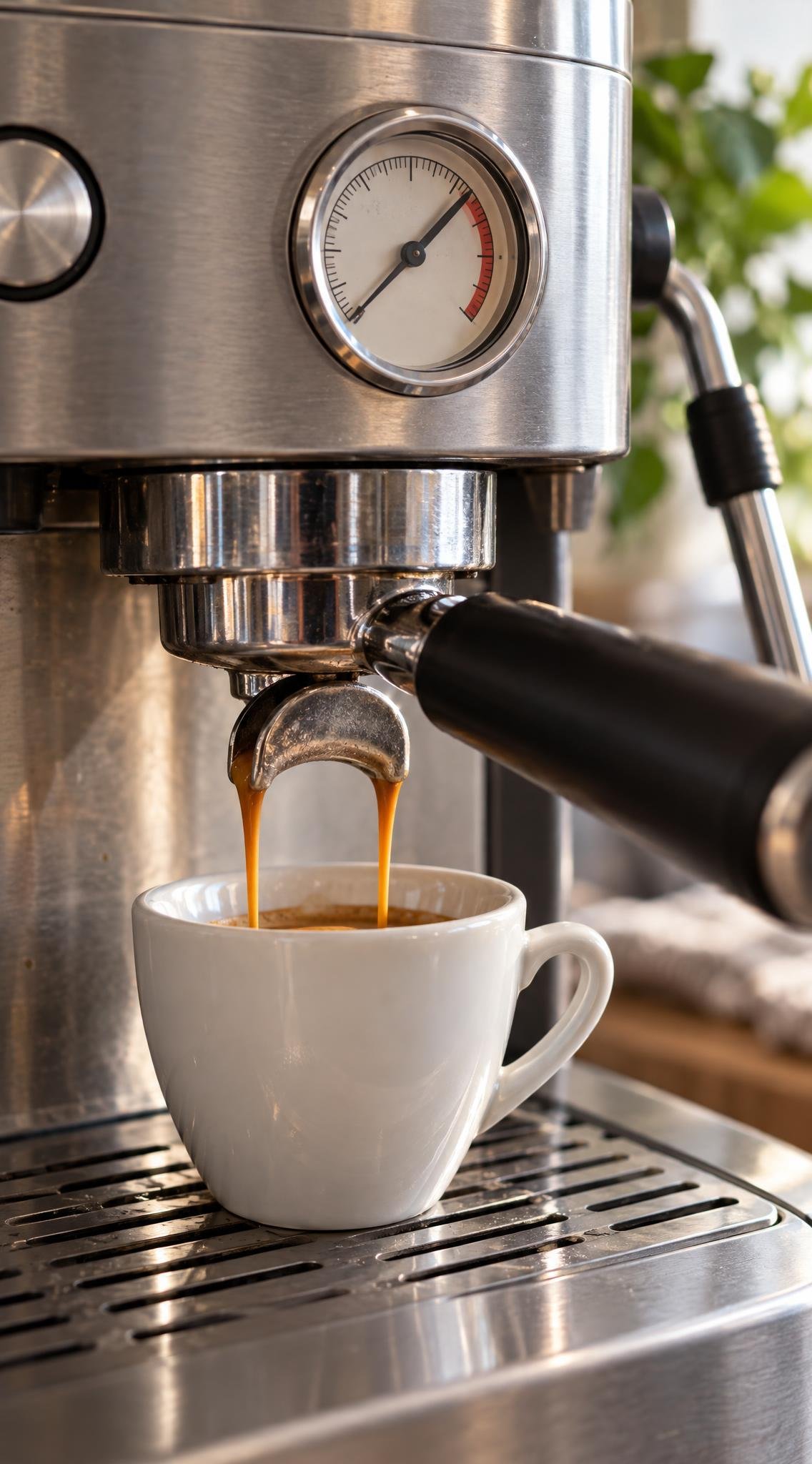
- Pressure gauge. The analog gauge on the front shows whether a shot is running in the espresso range, too low or too high. Many beginners find that visual feedback easier to learn from than a timer alone.
- Simple controls. A grind amount dial, a filter size button, and one cup and two cup buttons. There are no menus to learn.
- Value. It usually sits in a lower price tier than the Pro while sharing the same portafilter size, tank, hopper and basket set.
Where the Express falls short
- Only 16 grind settings. Owners often report that the right grind falls between two steps, so one click takes a shot from too fast to too slow. You then have to make up the difference with dose.
- Slower steam. The single-hole steam tip takes noticeably longer to heat a jug of milk. Reviewers commonly put it at well over a minute for one latte.
- No shot timer. You will want a separate scale with a timer to dial in properly.
Breville Barista Pro: Strengths and Drawbacks
The Breville Barista Pro BES878 keeps the same basic layout and swaps in newer parts. The headline change is the ThermoJet heating system, which Breville says reaches extraction temperature in 3 seconds.
What the Pro does well
- Speed. Near instant start-up and a much shorter wait between pulling a shot and steaming milk. That matters most on busy weekday mornings.
- 30 grind settings. Nearly twice as many steps as the Express, which makes it easier to land a shot in the usual 25 to 30 second window.
- LCD with shot timer. The screen shows grind setting, grind time and a live shot timer, and lets you program shot volume, water temperature and pre-infusion.
- Stronger steam wand. The four-hole tip moves more steam than the Express’s single-hole tip. Published reviews commonly report milk for a latte done in under a minute, roughly half the time of the Express.
Where the Pro falls short
- No pressure gauge. You judge a shot by time, yield and taste. That is how most baristas work anyway, but some buyers miss the dial.
- It heats fast, but the metal does not. The water is ready in seconds while the group head and portafilter are still cold. Owners widely recommend running a blank shot of hot water through the portafilter first.
- Faster steam is less forgiving. A four-hole tip gives a new user less time to get the milk texture right.
Heating System and Heat-Up Time: Thermocoil vs ThermoJet
This is the biggest practical difference. The Express’s Thermocoil needs around half a minute to a minute before the first shot, then more time to climb to steam temperature. The Pro’s ThermoJet is ready for espresso in about 3 seconds and moves to steam much faster.
If you make one straight espresso a day, the heat-up gap is a small convenience. If you make two or three milk drinks back to back, it adds up quickly.
Grinder Settings: Is 30 Really Better Than 16?
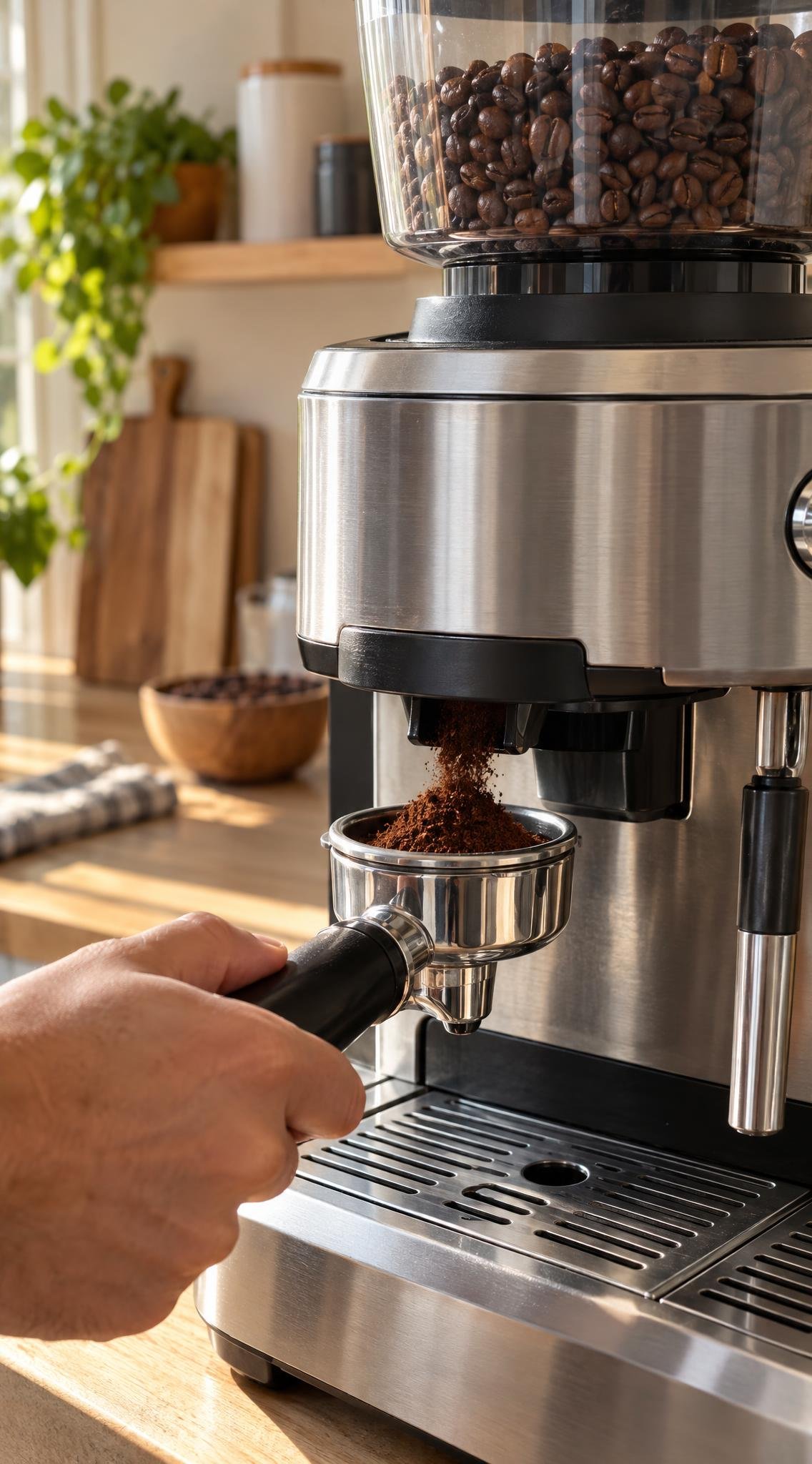
Yes, for dialing in. Both grinders use conical burrs and dose directly into the portafilter, but the Pro’s 30 steps are finer increments than the Express’s 16. Smaller steps mean smaller changes in shot time.
On either machine, the built-in grinder is the limiting part compared with a good standalone espresso grinder. Fresh beans and a scale close most of that gap. Our guide on how to dial in espresso walks through the 18 g in, 36 g out starting recipe that works on both.
Display and Interface: Pressure Gauge or LCD?
The Express gives you buttons, dials and a pressure gauge. The Pro gives you an LCD screen with a shot timer and no gauge.
The gauge tells you something is off, while the timer helps you measure how far off it is. If you plan to use a small espresso scale with a timer either way, the Express’s missing timer stops being a problem and its gauge becomes a bonus.
Steam Performance: Which Is Better for Lattes?
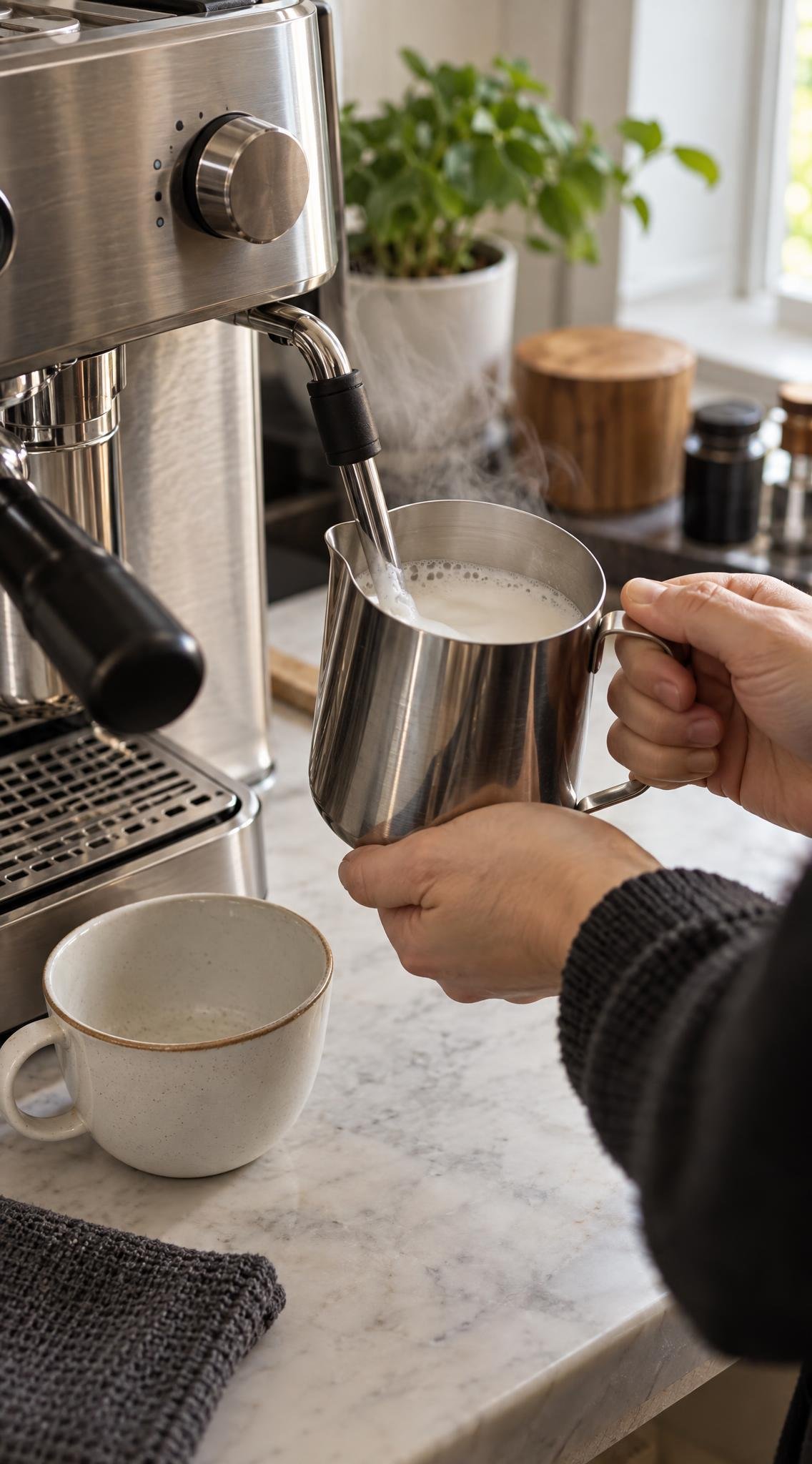
The Barista Pro. Its four-hole steam tip and faster heater texture milk in roughly half the time reviewers report for the Express, and you wait less between the shot and the steam. Both wands are manual, so you still learn to stretch and swirl the milk yourself.
The Express can make very good microfoam. It just takes longer, which gives beginners more time to react. A 12 oz milk frothing pitcher suits single lattes on both machines, and a clip-on milk thermometer helps while you are learning.
Size and Counter Space
These two are close enough that size should not decide it. Both share the 67 oz rear tank and 1/2 lb top hopper, and both need clear space above to refill beans and behind or beside to lift the tank out. Retailer listings put the Express at about 23 lb and the Pro at about 20 lb.
Learning Curve: Which Is Easier for a Beginner?
Both are beginner friendly, in different ways. The Express teaches with its gauge and has fewer settings to think about. The Pro guides you with a screen and timer and gives you finer grind control, so shots are easier to repeat once you find a recipe.
Expect to use several shots dialing in each new bag on either machine.
Who Should Buy the Barista Express and Who Should Buy the Barista Pro?
Choose the Barista Express if:
- You want the lower price tier and would rather spend the difference on beans and accessories.
- You mostly drink espresso or americanos, or make one milk drink at a time.
- You like a physical pressure gauge and simple buttons.
Choose the Barista Pro if:
- You make lattes, cappuccinos or flat whites most days, or for more than one person.
- You want finer grind steps and a built-in shot timer for dialing in.
- Your mornings are rushed and a 3 second start matters.
For a deeper look at the older machine on its own, read our Breville Barista Express review.
Alternatives: Barista Express Impress and Barista Touch
Breville Barista Express Impress
The Breville Barista Express Impress BES876 is built for people who find dosing and tamping the hard part. It adds intelligent dosing that corrects the next dose automatically and an assisted tamping lever that applies a consistent 22 lb press with a 7 degree twist. It has 25 grind settings and uses a Thermocoil heater like the Express, so it does not have the Pro’s 3 second heat-up.
Breville Barista Touch
The Breville Barista Touch BES880 sits in the premium tier. It pairs the ThermoJet heater and 30 grind settings with a touchscreen and an automatic steam wand that textures milk to a set temperature and foam level. You can save up to 8 personalized drinks.
You can see how all four fit against other brands in our roundup of the best home espresso machines.
Marcus’s Pro Tips
- Warm the portafilter on the Pro. Lock it in and run a blank shot before your first espresso. The water heats in seconds but cold metal will pull heat out of the shot.
- Weigh, do not guess. Start at 18 g in and 36 g out in 25 to 30 seconds on either machine. The grind amount dial is a timer, not a scale, so the dose shifts as you change grind size.
- Use the single wall basket with fresh beans. Save the dual wall basket for pre-ground or older coffee.
- Stir before you tamp. A WDT distribution tool breaks up clumps from the built-in grinder and reduces channeling.
- Purge and wipe the steam wand every time. A two second burst before and after steaming keeps milk out of the tip, which matters even more on a four-hole tip.
Useful Add-Ons for Either Machine
Nice to Have (both use 54 mm parts)
54 mm calibrated tamper – more consistent than a light stock tamper
54 mm bottomless portafilter – shows channeling as you pull the shot
Espresso knock box – quick puck cleanup between shots
Espresso machine cleaning tablets – for the cleaning cycle both machines prompt for
Frequently Asked Questions
Is the Breville Barista Pro worth the extra money over the Barista Express?
It is worth it if you make milk drinks often or value speed, because the faster heater, four-hole steam wand and 30 grind settings save time every day. If you mostly drink straight espresso and are happy to wait a minute, the Express gives you very similar results in a lower price tier.
Does the Barista Pro make better espresso than the Barista Express?
Slightly more consistent, not dramatically better. Both use a 54 mm portafilter, PID temperature control and pre-infusion. The Pro’s finer grind steps and shot timer make it easier to hit and repeat a good recipe.
Which is better for beginners, the Barista Express or the Barista Pro?
Either works for a first machine. The Express is simpler and its pressure gauge gives clear visual feedback. The Pro’s screen and timer make it easier to follow a recipe by the numbers.
How long does each machine take to heat up?
Breville states the Barista Pro’s ThermoJet system reaches extraction temperature in 3 seconds. Published figures for the Barista Express range from about 30 seconds to a minute. On both, the portafilter itself needs extra time or a blank shot to warm through.
Should I buy the Barista Express Impress instead?
Consider it if tamping and dosing worry you more than heat-up time. The Impress adds assisted tamping and automatic dose correction and has 25 grind settings, but it keeps the slower Thermocoil heater.
The Verdict: Barista Express or Barista Pro?
For most people who drink lattes and cappuccinos, the Breville Barista Pro is the better buy: 3 second heat-up, 30 grind settings, a shot timer and faster steam make the daily routine shorter and more repeatable. The Breville Barista Express remains a smart pick if you want to spend less, mostly drink espresso, or like having a pressure gauge. With fresh beans and a scale, both can pull a very good shot.
Still comparing? See our guides to the best coffee makers with a grinder and the best home espresso machines, and check the current price of both machines on Amazon before you decide.

Marcus Webb writes about home coffee for BrewElevate. He researches and compares brewing gear, beans and recipes so home brewers can make a better cup without overspending. His rule: if he wouldn’t be comfortable buying it himself, it doesn’t make the list.