Breville vs De’Longhi Espresso Machines: Which Brand Should You Buy?
Short on time?
Choose Breville if you want to make espresso by hand with a portafilter and a steam wand, and you want the machine to coach you with better grinders, faster heat-up and assisted tamping. Choose De’Longhi if you want a true bean-to-cup machine that grinds, brews and froths milk at the press of one button, or if you want the lowest-cost way into espresso. Breville does not make a one-touch super-automatic, and De’Longhi’s semi-automatic grinders have fewer settings, so the right brand depends on how hands-on you want to be.
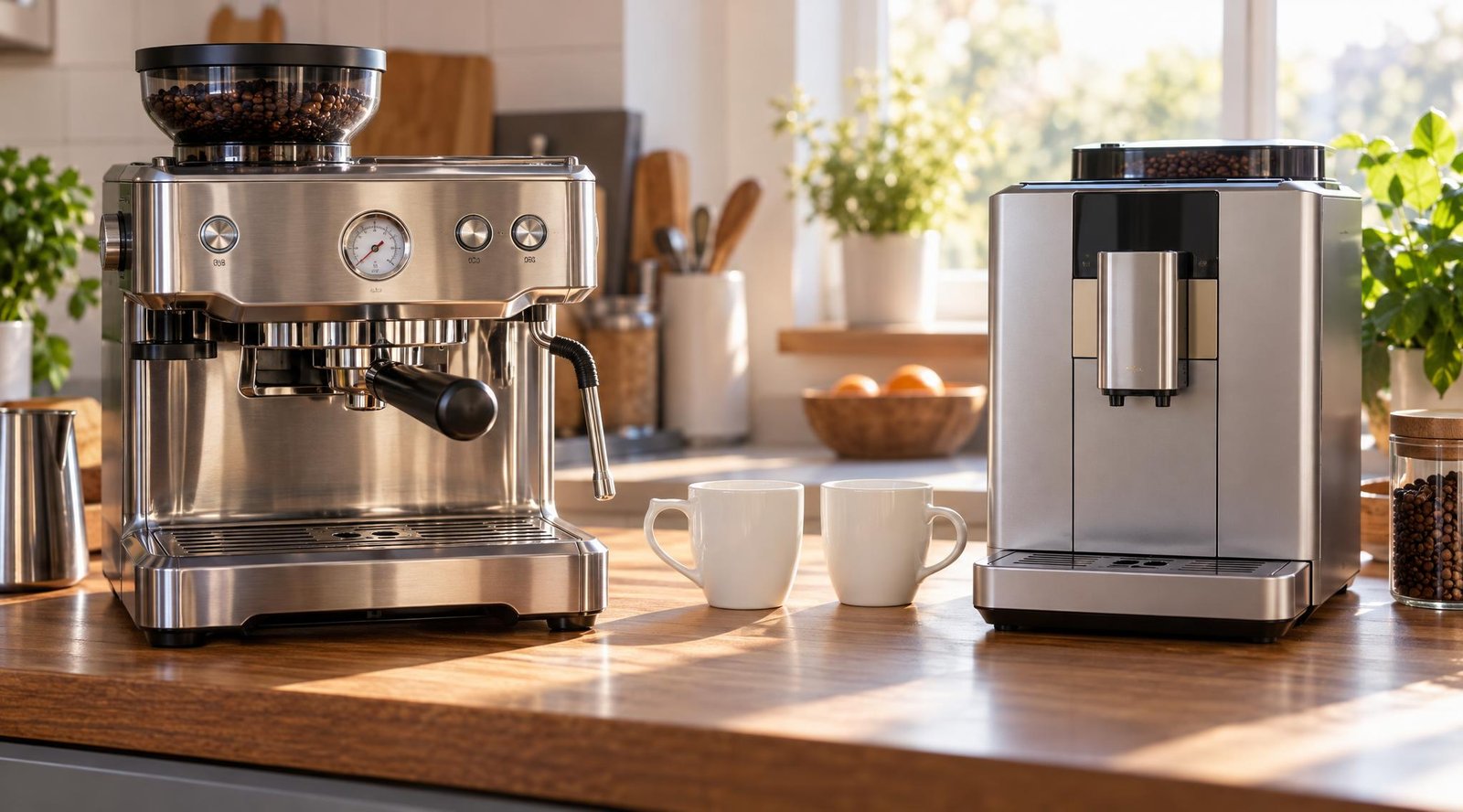
In a Breville vs De’Longhi espresso machine comparison, Breville is the stronger brand for hands-on, cafe-style espresso, and De’Longhi is the stronger brand for one-touch convenience and tight budgets. Breville builds semi-automatic machines with a portafilter at every tier, while De’Longhi sells both semi-automatics and fully automatic bean-to-cup machines.
This comparison is based on manufacturer specifications, published features and common owner feedback, not hands-on testing. Below you will find both brands’ current home lineups side by side at three tiers, with real model examples, honest drawbacks and a clear pick for each kind of coffee drinker. Prices move often, so check the current price on Amazon before you decide.
Quick Picks by Tier
Breville Bambino Plus (BES500BSS) – compact entry machine with automatic milk frothing
De’Longhi Stilosa (EC260BK) – simple budget starter with a manual frother
Breville Barista Express (BES870XL) – mid-range all-in-one with a 16-setting grinder
De’Longhi La Specialista Arte Evo (EC9255M) – mid-range all-in-one with a cold brew preset
Breville Oracle Jet (BES985BSS) – splurge machine that grinds, doses and tamps for you
De’Longhi Magnifica Evo (ECAM29084SB) – one-touch bean-to-cup lattes and cappuccinos
Breville vs De’Longhi at a Glance
| Feature | Breville | De’Longhi |
|---|---|---|
| Machine types | Semi-automatic and assisted machines, all with a portafilter | Semi-automatics plus fully automatic bean-to-cup machines |
| Entry level examples | Bambino, Bambino Plus | Stilosa, Dedica Arte |
| Built-in grinder examples | Barista Express (16 settings), Barista Express Impress (25 settings) | La Specialista Arte Evo (8 settings), La Specialista Opera (15 settings) |
| Premium examples | Barista Touch Impress (30 settings), Oracle Jet (45 settings) | Magnifica Evo and Eletta Explore (13 settings each) |
| Portafilter size | 54 mm on Bambino and Barista models, 58 mm on the Oracle Jet | 51 mm on the La Specialista Arte Evo. Bean-to-cup models have no portafilter. |
| Milk | Steam wand on every machine, manual or automatic | Steam wand on semi-automatics, LatteCrema automatic milk system on bean-to-cup models |
| One-touch milk drinks | No. You still move the portafilter and the milk jug. | Yes, on Magnifica Evo and Eletta Explore |
Entry Level: Breville Bambino vs De’Longhi Stilosa and Dedica

Breville Bambino and Bambino Plus
The Breville Bambino (BES450BSS) and Bambino Plus are small machines without a grinder. Both use Breville’s ThermoJet heating system, which reaches extraction temperature in about 3 seconds, a 54 mm portafilter and a 15 bar pump with low-pressure pre-infusion.
The Bambino has a manual steam wand. The Bambino Plus adds an automatic steam wand with adjustable milk temperature and texture, plus a 64 oz water tank in a body under 8 inches wide. The drawbacks: neither has a grinder, so you need to budget for one, and the light body can slide on the counter when you lock in the portafilter.
De’Longhi Stilosa and Dedica Arte
The Stilosa is De’Longhi’s budget starter. It has a 15 bar pump, a stainless steel boiler, a manual milk frother, a 33.8 oz water tank and a simple dial, and it takes E.S.E. pods as well as ground coffee. The trade-off is that it gives you very little help: no shot programming, no temperature options and a small tank.
The De’Longhi Dedica Arte (EC885M) is the step up. It is about 6 inches wide, uses a thermoblock heater and a 15 bar pump, has a 35 oz tank and comes with the My LatteArt steam wand and programmable shot buttons. Its included baskets are pressurized, which is forgiving with pre-ground coffee but limits how far you can refine a shot.
Entry level winner: the Bambino Plus for features and room to grow, the Stilosa for the tightest budget, and the Dedica Arte for the narrowest counter.
Mid-Range With a Built-In Grinder: Barista Express vs La Specialista

Breville Barista Express and Barista Express Impress
The Barista Express is the machine most people picture when they think of Breville. It combines a conical burr grinder with 16 grind settings, a thermocoil heating system with PID temperature control, a 15 bar pump with pre-infusion, a 54 mm portafilter, a 67 oz water tank, a pressure gauge and a manual steam wand. You get both single wall and dual wall baskets, so you can start easy and move to unpressurized shots later. We cover it in depth in our Breville Barista Express review.
The Breville Barista Express Impress (BES876BSS) keeps the same thermocoil core and adds 25 grind settings, intelligent dosing that remembers and corrects the last dose, and a lever that tamps with a steady 22 lb of force and a 7 degree twist.
Drawbacks: owners commonly report a learning curve of a week or two, the thermocoil steams milk more slowly than Breville’s newer ThermoJet machines, and the grinder steps can feel wide when you are chasing a perfect shot.
De’Longhi La Specialista Arte Evo and Opera
The La Specialista Arte Evo pairs a conical burr grinder with 8 grind settings, a thermoblock, a 15 bar pump, a 51 mm portafilter, a water tank of about 56 oz, three infusion temperatures and a commercial-style steam wand. It ships with a dosing funnel, tamper and tamping mat, and it has presets for espresso, americano, cold brew and hot water. Cold Extraction Technology makes a cold brew style drink in under 5 minutes.
The De’Longhi La Specialista Opera (EC9555M) moves up to 15 grind settings, a 19 bar pump, a 67.6 oz tank and Smart Tamping, where you pull a lever on the machine to tamp with even pressure. It also adds an Espresso Cool preset.
Drawbacks: 8 grind settings on the Arte Evo is half of what the Barista Express offers, and reviewers often point to this as the limit when dialing in lighter roasts. The 51 mm portafilter also has fewer aftermarket baskets and tampers than Breville’s 54 mm size, and published reviews of the quick cold brew are mixed.
Mid-range winner: Breville for grind control and upgrade path. De’Longhi if cold drinks and temperature presets matter more to you than fine grind steps.
Premium and Automatic: Oracle Jet and Barista Touch Impress vs Magnifica Evo and Eletta Explore
Breville Barista Touch Impress and Oracle Jet
The Breville Barista Touch Impress (BES881BSS) has a color touchscreen with step-by-step guidance, 30 grind settings on Baratza conical burrs, ThermoJet 3 second heat-up, assisted tamping and Auto MilQ, an automatic steam wand with 8 texture levels and settings for dairy, almond, oat and soy milk. It uses a 54 mm portafilter and a 67.6 oz tank.
The Oracle Jet is the splurge option. It grinds, doses and tamps automatically into a 58 mm portafilter that holds a 22 g dose, with 45 grind settings, a ThermoJet heater, a touchscreen, Auto MilQ milk texturing, a 77 oz water tank, and both cold brew and cold espresso modes.
Drawbacks: these are still portafilter machines. You lock in the handle, move the milk jug and knock out the puck after every drink, and both sit firmly in the premium to splurge tiers.
De’Longhi Magnifica Evo and Eletta Explore
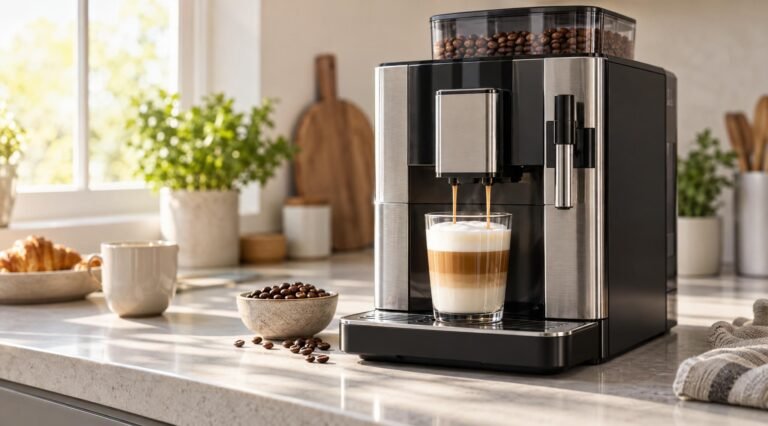
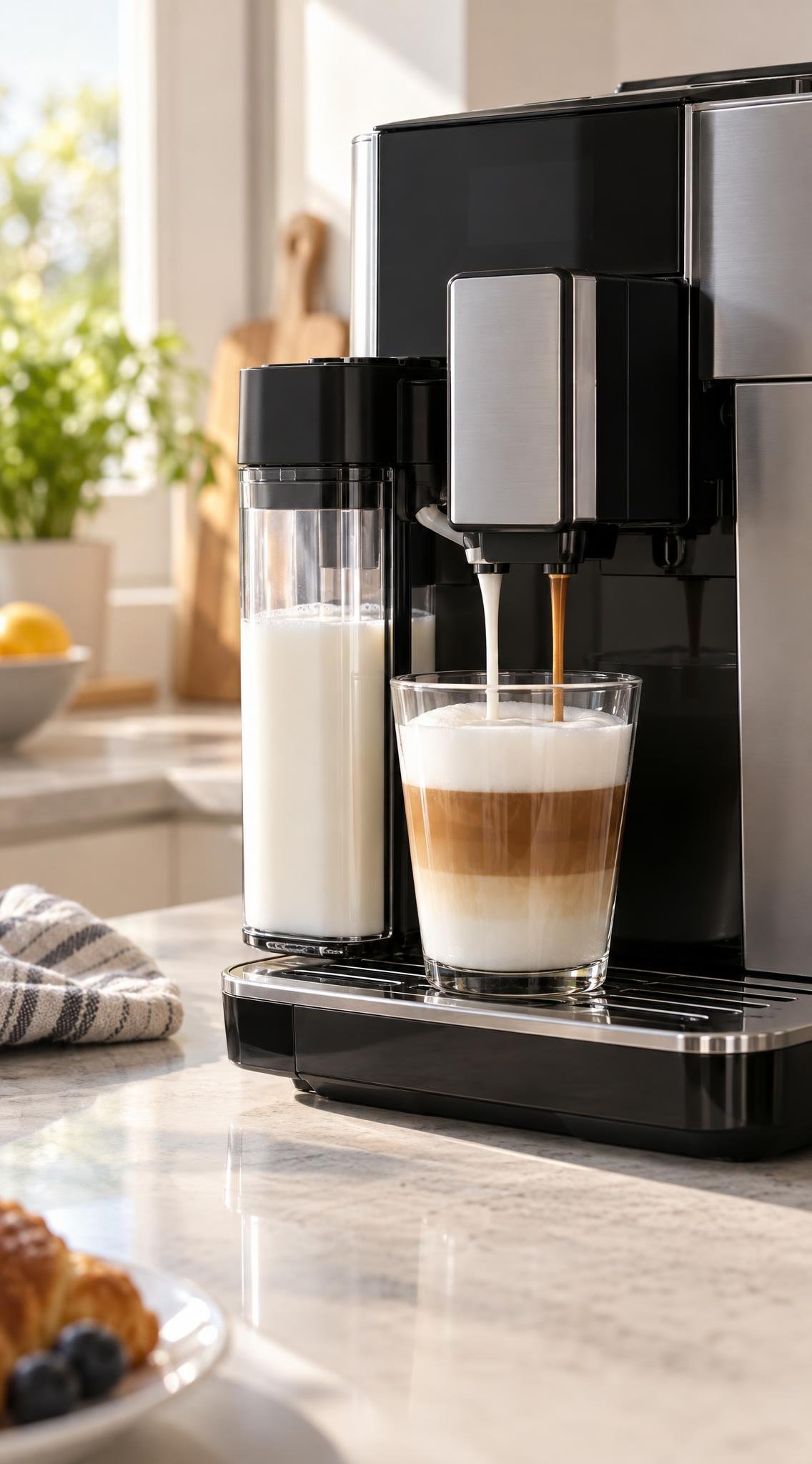
The Magnifica Evo is a true bean-to-cup machine. It has a conical burr grinder with 13 settings, a 15 bar pump, a 60 oz tank, an 8.8 oz bean hopper, a removable brew group and the LatteCrema automatic milk system. Seven one-touch recipes cover espresso, coffee, cappuccino, latte macchiato, iced coffee, hot water and My Latte.
The De’Longhi Eletta Explore (ECAM45086S) adds a 3.5 inch touch display, Wi-Fi, more than 50 hot and cold recipes, separate LatteCrema systems for hot and cold foam, a 19 bar pump and cold brew in under 3 minutes.
Drawbacks: bean-to-cup machines trade control for convenience. You cannot change the basket, tamp or pre-infusion the way you can on a Breville, published reviews tend to describe the espresso as good but less refined, and the Magnifica Evo has soft-touch icon buttons, not a full touchscreen, and no saved user profiles. The milk system and brew group also need regular rinsing.
Premium winner: Breville for espresso quality with heavy assistance, De’Longhi for genuine one-touch drinks.
Which Brand Has the Better Grinder?
Breville has the clear edge on built-in grinders. Its settings climb from 16 on the Barista Express to 25, 30 and 45 on higher models, and its newer machines use Baratza burrs. More steps means smaller adjustments, which is what you need when you dial in espresso.
De’Longhi’s semi-automatic grinders offer 8 or 15 settings, and its bean-to-cup machines offer 13. That is plenty for a machine that manages the dose and brew for you, but it is a real limit on a manual machine. If you want other all-in-one options, see our guide to the best coffee makers with a grinder.
Milk Systems: Steam Wand vs LatteCrema

Every Breville espresso machine uses a steam wand. On the Bambino and Barista Express it is fully manual. On the Bambino Plus, Barista Touch Impress and Oracle Jet it is automatic: you set a temperature and texture, place the jug and the wand stops by itself. You still pour the milk into the cup, which also means you can practice latte art.
De’Longhi uses steam wands on the Stilosa, Dedica Arte and La Specialista machines. Its bean-to-cup models use LatteCrema, which pulls milk from a carafe and dispenses foam straight into the cup. That is less work per drink, with more parts to clean and less control over texture.
Build Quality and Ease of Use
Breville machines lean on brushed stainless steel housings and feel consistent across the range, with clear gauges or touchscreens. De’Longhi varies more by line: the Stilosa uses a lot of plastic and weighs under 9 lb, while the La Specialista Opera is a metal-bodied machine at around 28 lb.
For ease of use, a De’Longhi bean-to-cup machine is the simplest thing either brand sells. Among portafilter machines, Breville’s Impress and Oracle models do more to guide a beginner than De’Longhi’s La Specialista line. Warranty terms differ by model and retailer for both brands, so check the listing before you buy.
Who Should Buy Breville and Who Should Buy De’Longhi?
- Buy Breville if you want to learn espresso as a hobby, you care about grind control, you want an automatic steam wand that still makes real microfoam, or you plan to upgrade baskets and accessories later.
- Buy De’Longhi if you want a latte from one button, several people in your home just want coffee fast, you are on a tight budget, your counter is very narrow, or you drink a lot of iced and cold coffee.
Marcus’s Pro Tips
- Count the grinder in your budget. The Bambino, Stilosa and Dedica need a separate burr grinder to perform well. An all-in-one may cost less overall.
- Match the machine to your morning. If you have two minutes before work, a bean-to-cup machine will get used. A portafilter machine rewards people who enjoy the routine.
- Check the portafilter size before buying accessories. Tampers and baskets for 51 mm, 54 mm and 58 mm are not interchangeable.
- Measure under your cabinets. Many of these machines fill from the top or back, so leave room to lift the tank and open the hopper.
Frequently Asked Questions
Is Breville better than De’Longhi for espresso?
For hands-on espresso, Breville is generally the better choice because its machines offer more grind settings, PID temperature control and unpressurized baskets. De’Longhi is better if you want one-touch drinks or the lowest entry cost. Neither brand is better for everyone.
Does Breville make a super-automatic espresso machine?
No. Breville’s most automated machines, such as the Oracle Jet, grind, dose, tamp and froth milk automatically, but you still move a portafilter and a milk jug. For a true bean-to-cup machine, look at De’Longhi’s Magnifica Evo or Eletta Explore.
Which is easier for a beginner, the Breville Barista Express or the De’Longhi La Specialista Arte Evo?
Both suit beginners. The La Specialista Arte Evo has drink presets and three temperature settings that make the first week simpler. The Barista Express has 16 grind settings and a pressure gauge that make it easier to improve over time.
Which brand is better for lattes and cappuccinos?
If you want the machine to do it all, De’Longhi’s LatteCrema system dispenses frothed milk into the cup at the press of a button. If you want cafe-style microfoam and latte art, Breville’s automatic steam wands on the Bambino Plus, Barista Touch Impress and Oracle Jet are the better fit.
Which lasts longer, Breville or De’Longhi?
Neither brand publishes lifespan figures, and owner experience varies by model. For both, regular descaling, water filter changes and cleaning matter more than the badge. Check the warranty on the exact model you are buying.
Do Breville and De’Longhi machines make cold brew?
Some do. De’Longhi offers cold extraction on the La Specialista Arte Evo, La Specialista Opera and Eletta Explore, and Breville offers cold brew and cold espresso on the Oracle Jet. These are fast, machine-brewed cold drinks, so expect a different taste from coffee steeped overnight.
Breville vs De’Longhi: The Verdict
Pick Breville if you want to make espresso yourself and get better at it. The Bambino Plus, Barista Express and Oracle Jet give you more grind control and more room to grow at each tier. Pick De’Longhi if you want coffee with the least effort or the smallest spend: the Stilosa on a budget, the La Specialista Arte Evo for presets and cold drinks, and the Magnifica Evo for one-touch lattes.
For more options across both brands and beyond, see our guide to the best home espresso machines. Shopping for someone else? Our best coffee gift sets pair well with a new machine.

Marcus Webb writes about home coffee for BrewElevate. He researches and compares brewing gear, beans and recipes so home brewers can make a better cup without overspending. His rule: if he wouldn’t be comfortable buying it himself, it doesn’t make the list.